
Does kelp help the climate?
Words by Jessica Kennedy, photos by Benthics.
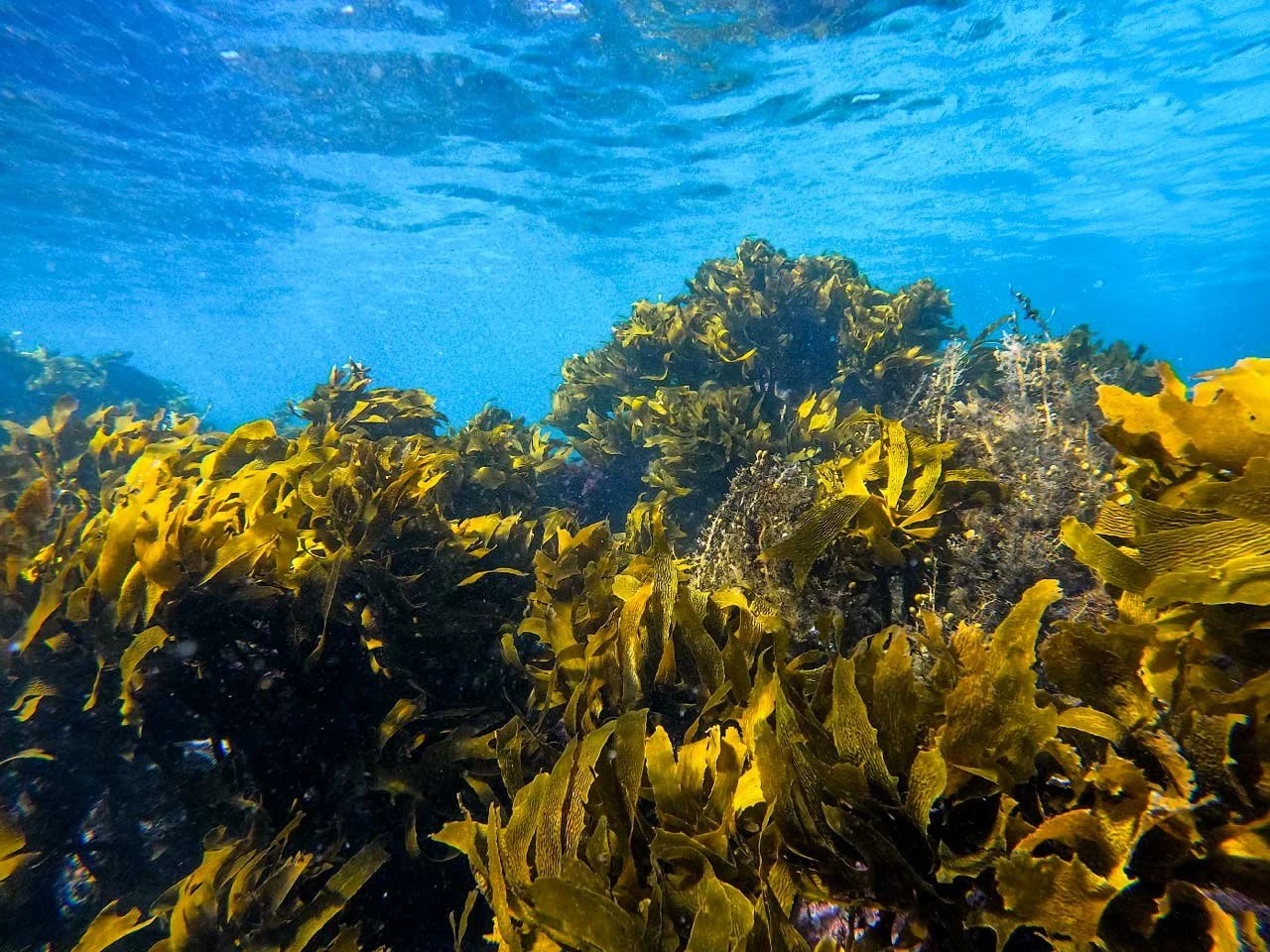
Kelp forests, like this one in Tīkapa Moana the Hauraki Gulf, are estimated to cover around a third of the world’s coastlines.
“The number of animals of all orders, whose existence intimately depends on giant kelp, is wonderful.”
(Charles Darwin)
When Charles Darwin first saw the giant kelp forests in Patagonia he was amazed by all of the diversity that these sea plants supported. In fact, he was the first to coin the term “kelp forests” since he noticed that kelps grow tall like trees on land, providing habitat and supporting a wide array of different creatures.
Today, kelp forests are estimated to cover around a third of marine coastlines globally. Kelps are a type of large seaweed, often referred to as macroalgae. They thrive in cold, nutrient rich waters, and they are especially well adapted to living in areas with high wave action. Thanks to something called a holdfast (the seaweed equivalent to tree roots), individual kelp plants secure themselves to the rocky reef as they grow, and contribute to a canopy of sometimes thousands of plants stretching kilometres along the coast.
Fundamentally, kelp forests have intrinsic value, because thriving, healthy, natural ecosystems are valuable in and of themselves. Kelps also ‘sequester’ carbon, which means that they draw down carbon dioxide during photosynthesis (converting light into energy) and store it as organic carbon in their tissues. Some of this kelp carbon can remain stored in stable forms for long timescales, locking this carbon away from re-entering the atmosphere where it would contribute to climate change.
Kelps, the climate defenders
Measuring the role that kelp forests play in buffering climate change is not easy. We know that kelps absorb huge amounts of carbon through their lifetime as they continually grow and shed, like a conveyor belt. After they draw carbon down, they release it through tissue erosion, and when they die at the end of their natural lifecycle. Understanding how long kelp-produced organic carbon stays in the ocean, once released, is a key piece of research that is being carried out globally, and it is critical to understanding the contribution kelp forests make to climate change mitigation. The current benchmark for effective carbon storage is usually around 100 years, but kelp plants only live for a few years so the challenge is understanding where organic kelp carbon ultimately ends up.
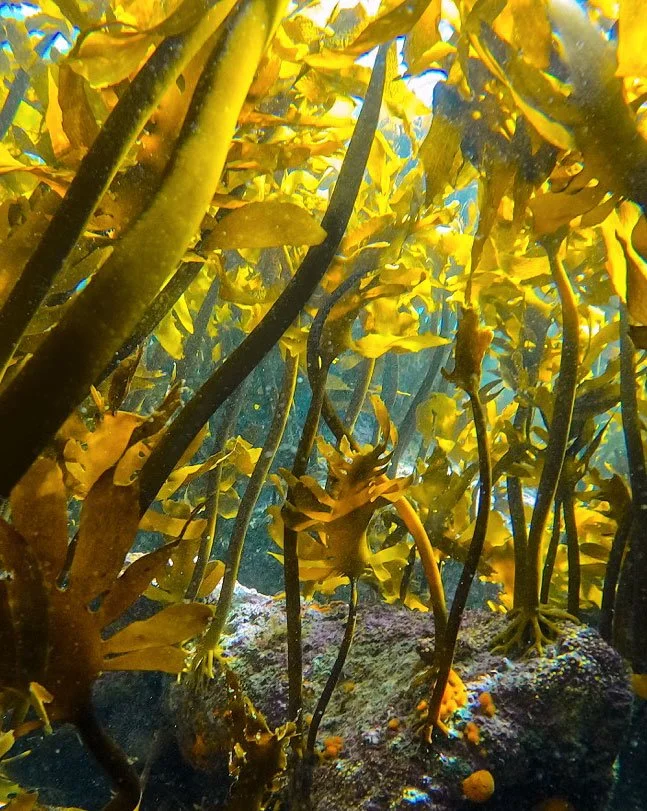
“kelps absorb huge amounts of carbon through their lifetime as they continually grow and shed tissue like a conveyor belt.”
Kelp plants use a holdfast to attach to rocky substrate, and contribute to a much larger kelp forest canopy (above).
Kelps are some of the fastest growing plants on earth (some species are estimated to grow as much as half a metre in a single day). Since they cover such vast areas, they are constantly releasing large quantities of organic carbon collectively into the ocean. Kelps release organic carbon in many forms, from microscopic fragments to an entire kelp plant washed away in a storm. However, where this carbon goes after it is released is not currently well understood. Some of the carbon produced by kelps may be transferred to the very deep ocean. If this is the case, then it is likely to be stored there for hundreds of years or more, drawing carbon out of the atmosphere and slowing the impacts of climate change. Carbon from kelp can also become buried in soft sediments (sandy/muddy areas on the seafloor) which also enables that kelp-produced carbon to be locked away for hundreds of years.
Painting a picture with ecological science
Ongoing scientific research is looking to find the answers to these questions and fill some of these gaps in our knowledge about where carbon produced by kelp ultimately goes. To understand the longevity of kelp carbon, Research Fellow Dr.Caitlin Blain and I have carried out experiments within Tīkapa Moana the Hauraki Gulf to investigate how long it takes for kelp to break down. Mesh bags were secured over kelp plants and anchored to the seafloor to measure how long it took for the kelp to decompose. This experiment can reflect an end of life scenario, but also the natural lost of kelp tissue through the constant growth and erosion cycle. We found that, on average, the kelp was completely gone within four months, and that the kelp degraded at a similar rate across the variable seafloor conditions.
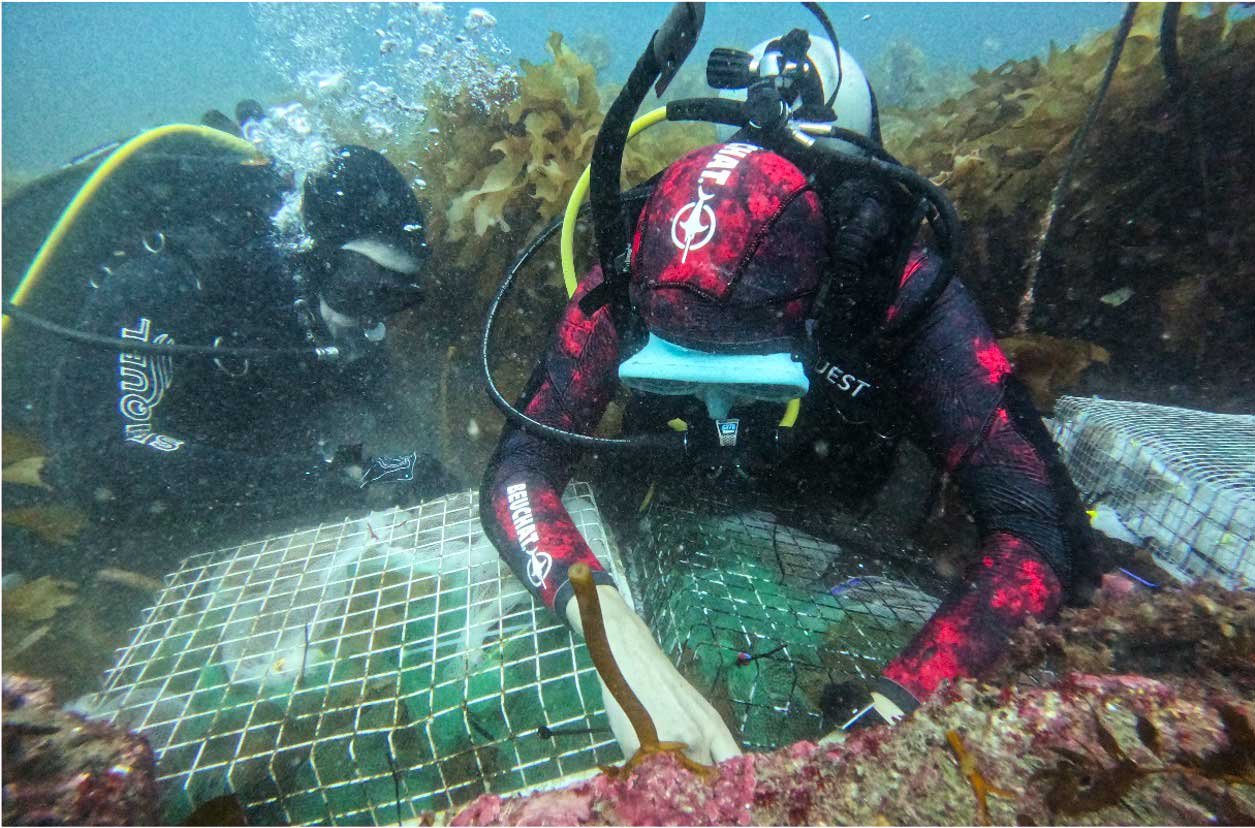
Dr. Caitlin Blain and PhD candiate Jessica Kennedy carrying out kelp decomposition experiments in Tīkapa Moana the Hauraki Gulf. (Photo:Kelsey Miller).
Sequestering carbon over meaningful timeframes
What does this mean for carbon storage? Well, it tells us that fragments of kelp have approximately four months to be transported to the deep ocean or soft sediment areas to potentially be stored for meaningful timescales (around 100 years) to contribute to climate change mitigation in Tīkapa Moana the Hauraki Gulf. The next piece of information that will help us determine how kelp helps the climate, is to track the movement of kelp detritus (decomposing kelp) through the Hauraki Gulf to determine where the kelp carbon is moving to after it is released from kelp plants. Also, understanding the longevity of the smaller fragments of carbon produced by kelps, including particulate and dissolved organic carbon, is another missing piece of key information that is needed to holistically understand kelp carbon sequestration potential.
Gaining a clearer understanding of the amount of carbon that is sequestered by kelp is instrumental in demonstrating the multiple benefits of healthy kelp forests and the role they potentially play in drawing down carbon, and ultimately fighting climate change. Proving that kelp forests sequester large quantities of carbon could help persuade important decision makers to support kelp protection and/or restoration projects such as TK Rewilding in the future.
About the Author
Jessica Kennedy is a PhD candidate at Waipapa Taumata Rau the University of Auckland studying kelp carbon cycling through a combination of lab work and underwater field experiments. She is originally from Canada but has been living just up the road from Te Kohuroa Matheson Bay for the past three years.