
A Witness to Change: interview with Mark Rykers
Edited by Joshua McKenzie-Brown.
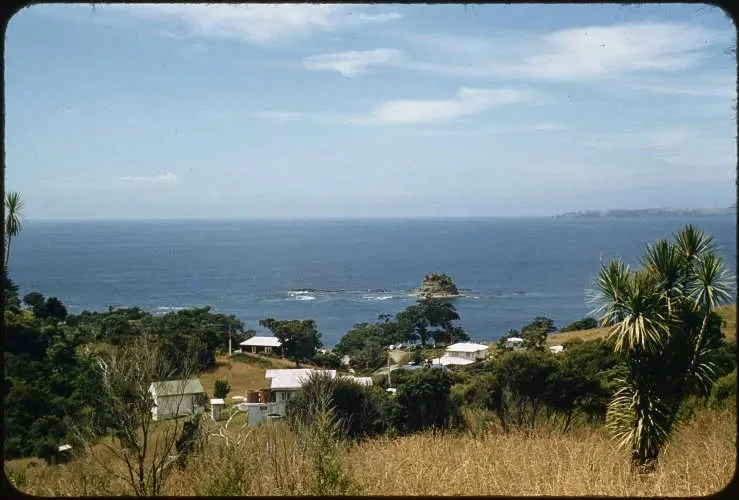
Te Kohuroa Matheson Bay in the 1958. (Photo: Harry Leonard Wakelin, Harry Leonard).
Mark Rykers remembers when the water at Te Kohuroa Matheson Bay was clear enough to see rocks on the seafloor out to the island.
Mark grew up with Te Kohuroa Matheson Bay as the backdrop to his childhood. His family bach sat on the ridge above Pink Beach, built by his father in the early 1960s on land subdivided from the old Kendale farm. Back then, there were few houses, little traffic, and almost no sense that the coast was under pressure. The landscape was open pasture, pohutukawa, and pockets of native bush clinging to the slopes. The bay felt remote, an almost undiscovered hideaway.
He and his siblings swam in the creek behind the beach, fished from the rocks, and rowed dinghies across the channel to the island. The bay, then, felt abundant, alive with fish, kelp, and movement. “The whole place was quite different. Few people. A gravel road all the way from Matakana, which was nothing in those days. There was the general store, the hall, and the sawmill.”
As a child, Mark spent most of his days by the sea. “There was just so much shellfish. The rocks were covered. You’d go down and there were masses of everything. We used to see blue mussels all through there. You’d take what you needed.”
He remembers rock pools crowded with cat’s eyes, periwinkles and small fish, pink shells strewn across the sand, and beds of shellfish exposed when the tide retreated. Butterfish flickered through the shallows, schools of piper on the surface, crayfish tucked into crevices. Even large snapper came in close, close enough to be caught from the rocks. At the time, he never thought it would change.
An underwater forest
Mark says kelp once formed dense underwater forests around the island, dominating the marine environment. Fishing from the rocks meant snagged lines and fouled hooks, inconveniences that spoke to a functioning, healthy ecosystem. “It was chock-a-block. You’d be pushing past it swimming through there. Fronds that reached up from the seabed. All the way around the back of the island.”
Where rocky substrate once prevailed, Mark recalls flat stones and boulders that were home to a variety of seaweed species, coralline algae, and the ubiquitous kelp. Even the channel between the island and the mainland, he remembers, was thick with ocean vegetation. “Full of kelp on both sides. Down at the bottom there wasn’t much, but around it - massive kelp beds.”
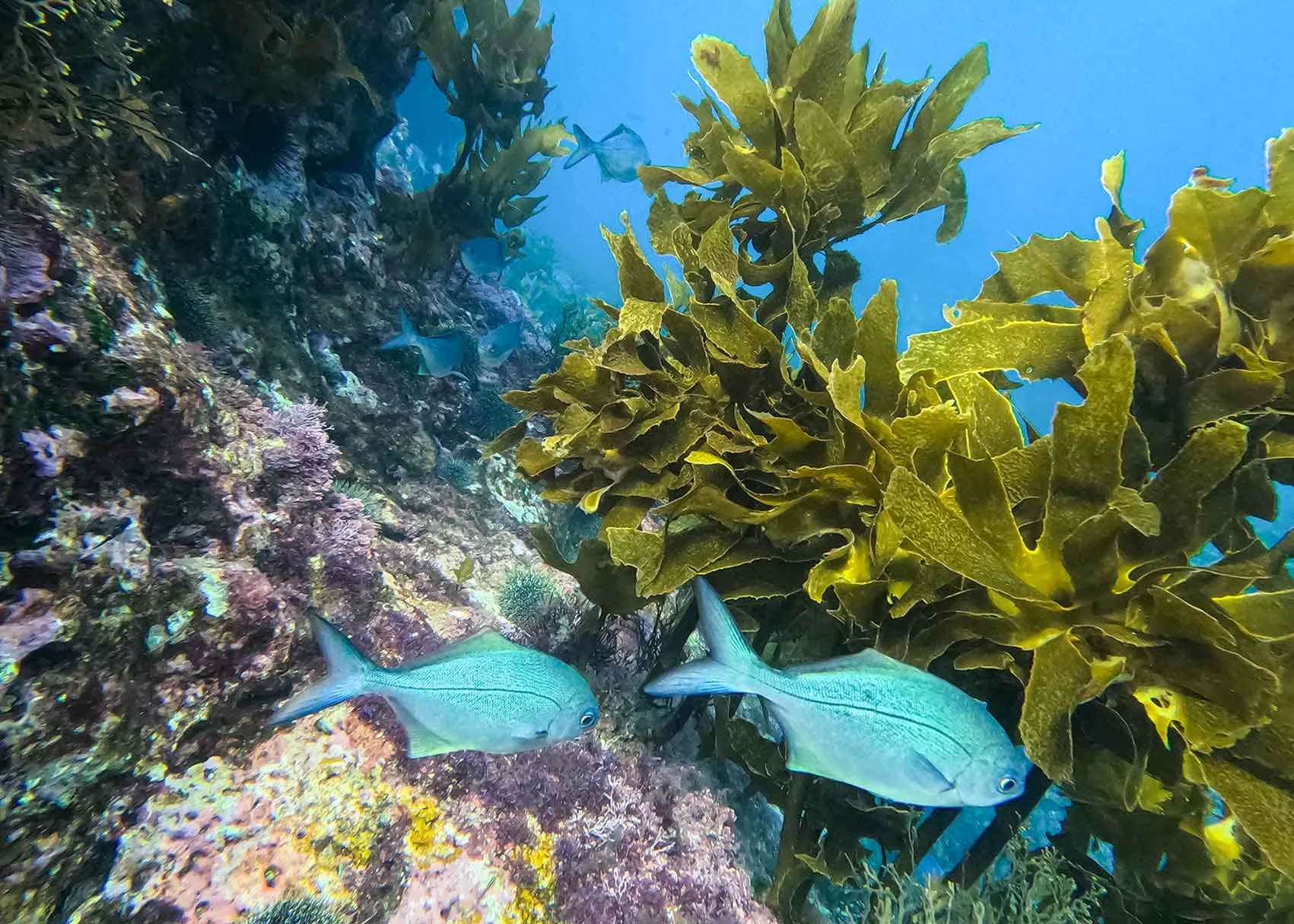
Te Kohuroa Matheson Bay’s reefs used to be densely covered in algae.
(Photo: Benthics.)
The change
The underwater world Mark describes is not the one he sees today. In recent years, sediment has begun to settle over the reefs and kelp, changing both visibility and habitat. “Round to the right now… I can write my name in the sediment on the kelp. You can touch it and it’ll come off in a big snow-shell. That was never like that.”
He says the bay used to recover faster. Heavy rain now sends plumes of fine mud offshore. Where storms once clouded the water briefly before the system flushed clean, sediment now lingers. “I don’t recall seeing that when I was younger. Occasionally, the water was dirty after big rains and seas, but not like this. Now it just seems to load constantly and lay up.”
Mark has also noticed changes in the seafloor's structure itself. Where rock once formed habitat for kelp and invertebrates, pale sand now stretches across parts of the bay floor. “When I snorkelled the other day, I could see sand miles out. There used to be lots of rocks out there, little flat rocks, with kelp and weed on them.”
He’s witnessed the rise of kina barrens in places too — a cascade effect triggered by the removal of their main predators: large snapper and crayfish, now rarely seen. Changing sea temperatures over the years appear to be playing their part as well. With colorful sponges beginning to suffer in unusually warm seasons and an increase in salps being observed.
A different kind of pressure
Alongside environmental change, Mark remembers a shift in how people treated the coastline compared to when he was younger. In the 1990s, he says, harvesting intensified. “They just stripped everything. Periwinkles, mussels, anything that could be pried loose. Sack after sack. You’d come back, and the rocks were bare. It was dead. There was nothing left.”
He saw similar patterns nearby. “Same thing happened at Lews Bay. Those pipi beds were amazing. Massive.”
What once felt like a place governed by restraint and balance became stripped. “People used to respect the place. They didn’t plunder it. The creek was swimmable back then, too. You could fish in it. Now it’s contaminated. You can’t go near it.”
Sharks in the bay
Today, bronze whalers are sometimes seen beyond the island. Mark reminisces about a mako shark coming into the shallows, attracted by fish waste left by divers. “When that mako turned up, people came down with pitchforks. Someone even came with a .22 rifle.Took a shot at it.” The incident feels distant now, a marker of a different time, when fear shaped responses more than understanding.
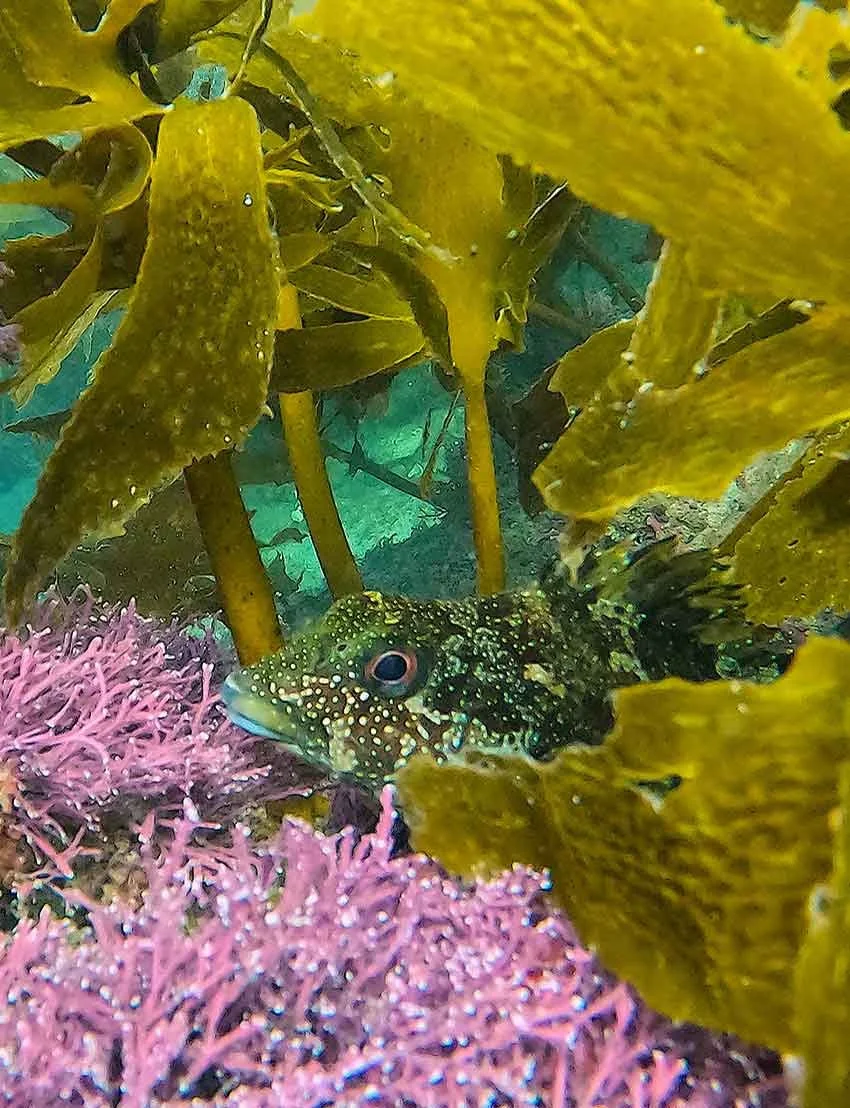
“Back then, there was kelp everywhere, shellfish on the rocks, fish coming right in close.”
- Mark Rykers
Recovery
When asked how it feels to return to Matheson Bay, Mark takes a moment to think. Heartbroken, he says, sums it up in a word. The abundance he grew up with has faded. Rich biodiversity has been replaced by something more fragile. “I feel … gutted, really. About what it was like and what it’s like now.”
Yet he remains cautiously optimistic. The bay he remembers is not a fantasy. He understands the complexity of the pressures facing the bay: warming seas, sedimentation, runoff, and the cumulative weight of human activity. But Mark also recognises that ecosystems can recover when given space and support. Restoration is possible, he believes, even if we can never return the bay to exactly as it was. Through efforts such as kina removal to kickstart kelp regrowth and catchment restoration to reduce sediment. “There’s still a point in trying to stop things getting worse, trying to restore what you can.”
Standing on the shore now, looking out over water that is still blue and clear on calm days, Mark holds two visions of Matheson Bay at once. “We were there at the best time, when the place was still quite pristine. Now it’s the influx of people and the impact on the water quality and aquatic life …” He pauses, then adds: “I feel heartbroken sometimes when I go in (underwater). But it’s not empty, and it’s not dead. It’s just not as it was.”
About the Editor
Joshua McKenzie-Brown is a freelance journalist and novelist whose work sits at the intersection of ocean conservation and crime fiction. A Coastguard volunteer, World Champion adaptive sailor, former biology teacher, and Te Kohuroa Rewilding Ranger, his writing examines human impact on the ocean through science-informed storytelling. Read more about Joshua’s latest novel, South Pacific Cut, here.